Why the Humble Dot Marker Page Is Quietly Revolutionizing Early Number Learning
In the crowded landscape of early childhood educational resources, it is rare to find a tool that genuinely balances developmental science with practical usability. Enter the 1–9 Numbers Dot Marker Pages for Kids, a printable activity set that has captured the attention of educators, content creators, and entrepreneurs alike. But this is not merely a coloring book with circles. This set represents a thoughtful convergence of fine motor skill development, number recognition, and the growing demand for low-prep, high-engagement learning materials. As more parents and teachers seek screen-free, hands-on activities that deliver measurable outcomes, the dot marker page has moved from a niche craft item to a staple in modern early learning environments.
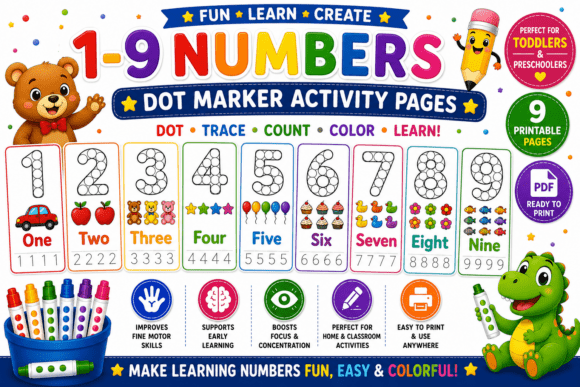
For professionals creating educational content—whether for classroom distribution, homeschool curricula, or KDP interior projects—understanding the structural and pedagogical value of these pages is essential. The 1–9 Numbers Dot Marker Pages for Kids are designed to guide toddlers and preschoolers through number recognition, counting, tracing, and coloring, all within a single page format. Each page features a large number with clean dot circles, themed objects to count, simple tracing lines, and kid-friendly illustrations that invite participation without overwhelming the child. This is not accidental design; it is the result of careful attention to how young children process visual information, build hand strength, and develop number sense.
Let us explore why this specific format is gaining traction, how it fits into broader trends in educational content creation, and what professionals in the space should consider when designing, selecting, or marketing such resources.
The Shift Toward Low-Prep, High-Impact Printable Resources
One of the most significant shifts in early childhood education over the past five years has been the move away from overly complex, multi-step learning activities toward simpler, more targeted tools. Teachers and parents alike report that time is the most scarce resource in a child's learning day. The 1–9 Numbers Dot Marker Pages for Kids directly address this constraint. A parent can print a page, hand the child a dot marker, and within moments the child is engaged in meaningful number work—identifying the numeral, counting objects, tracing the shape, and filling dots with color. There is no setup, no cleanup of multiple components, and no need for expensive manipulatives.
This simplicity does not mean the learning is shallow. On the contrary, the dot marker page compresses multiple skill areas into one activity: visual discrimination (finding the right number), fine motor control (placing the dot marker precisely), counting (matching objects to quantity), and pre-writing (tracing the number path). For content creators and educators, this efficiency is a major selling point. Parents are increasingly savvy about educational value density—they want products that deliver multiple developmental benefits in a single session. The dot marker page format checks that box cleanly.
From Niche Craft to Mainstream Learning Tool
Dot markers themselves were once considered a specialty art supply, primarily used in occupational therapy settings for children with fine motor delays. Today, dot markers are widely available in retail stores and are a common household item for families with young children. This market expansion has created a natural demand for printable pages that leverage the tool's unique properties. The 1–9 Numbers Dot Marker Pages for Kids capitalize on this trend by providing structured, educational content specifically designed for dot marker use—rather than generic coloring pages that happen to have circles.
What makes these pages particularly effective is the alignment between the tool and the task. The dot marker requires a vertical stamping motion that builds hand strength and control, while the clean dot circles on the page provide a clear target. This is different from traditional coloring, which demands sustained horizontal or circular motion. For toddlers and young preschoolers who are still developing wrist stability, the dot marker offers a more forgiving and successful first experience with mark-making. The number pages scaffold this further by combining dot filling with tracing lines, gently transitioning the child from stamping to linear drawing—a precursor to handwriting.
Why Professionals Are Paying Attention to This Format
For entrepreneurs and creators in the educational publishing space—particularly those involved in KDP interiors, printables marketplaces, or homeschool curricula—the 1–9 Numbers Dot Marker Pages for Kids represent more than a product; they represent a category with strong market fundamentals. The demand for printable educational activities has grown steadily, driven by several converging factors.
- Rise of homeschooling and microschools: Since 2020, the number of families choosing homeschool or small learning pods has increased significantly. These families need affordable, reproducible, and high-quality resources that do not require a full classroom budget. Printable dot marker pages fit that need perfectly.
- Screen time concerns among parents: A growing body of research on early screen exposure has led many parents to actively seek analog alternatives. Dot marker pages offer a tactile, offline experience that still feels fun and rewarding to young children.
- Teacher preference for reusable and flexible materials: Classroom teachers appreciate printable pages because they can be used in centers, sent home as practice, or laminated for repeated use with dry-erase markers. The dot marker format works well in all these scenarios.
- KDP and digital product market growth: Amazon's Kindle Direct Publishing and platforms like Teachers Pay Teachers have created a robust marketplace for educational printables. Products that solve a clear problem—like number recognition for toddlers—tend to perform well when designed with clear formatting and appealing illustrations.
These trends are not passing fads. The underlying needs—affordable resources, screen-free learning, developmental appropriateness, and ease of use—are structural shifts in how families and educators approach early education. The 1–9 Numbers Dot Marker Pages for Kids sit squarely at the intersection of these needs, which is why they have become a go-to resource for anyone creating content for the preschool demographic.
The Pedagogical Design Behind the Pages
Understanding why these pages work requires a closer look at their structure. Each page in a well-designed 1–9 Numbers Dot Marker Pages for Kids set is not simply a number with dots; it is a carefully sequenced learning zone. Let us examine the typical components and their developmental rationale.
The Large Number with Dot Circles
The central feature is a large numeral filled with evenly spaced circles designed for dot marker placement. This is more than decoration. The act of stamping inside a defined boundary trains visual-motor integration—the child must look at the circle, aim the marker, and apply the correct pressure. Repeating this across multiple circles reinforces the shape of the number in the child's mind. For a toddler, this multisensory input (seeing the number, saying its name, and physically stamping it) is far more effective than passive observation.
Themed Counting Objects
Each page includes a small set of themed illustrations—apples, stars, fish, or similar kid-friendly images—that correspond to the featured number. A page for the number 3 might show three balloons; the number 5 might show five buttons. This connects the abstract numeral to a concrete quantity, which is the foundation of number sense. The child is not just stamping; they are counting, subitizing (recognizing small quantities at a glance), and building one-to-one correspondence.
Simple Tracing Practice
Below or beside the large number, a tracing guide shows the number with dashed lines. This introduces the child to the motor sequence required to write the numeral. For many children, this is their first structured writing experience. The tracing path should be simple, with clear starting dots and directional arrows where appropriate. The 1–9 Numbers Dot Marker Pages for Kids typically include this element to bridge stamping (gross motor) and writing (fine motor), making the page useful across a wider age range—from 2-year-olds who only stamp to 4-year-olds ready to trace.
Easy-to-Color Designs
The overall page design should not overwhelm the child. Large, bold lines, ample white space, and recognizable objects help maintain focus. Cute but not overly detailed illustrations keep the child engaged without causing visual fatigue. For parents and teachers, this means fewer meltdowns and longer sustained attention spans—a practical benefit that cannot be overstated.
Practical Applications Across Settings
The versatility of the 1–9 Numbers Dot Marker Pages for Kids makes them suitable for a wide range of use cases. Here are several practical examples based on observations from educators and content creators who have integrated these pages into their offerings.
Preschool Classroom Centers
In a typical preschool classroom, teachers set up learning centers that children rotate through during free choice time. A dot marker number page can be placed at a math table or writing center alongside a basket of dot markers. The activity is self-directed: children select a page, work at their own pace, and experience success without constant teacher intervention. This frees the teacher to work with small groups or individual children who need extra support. The pages also serve as quick assessment tools—teachers can see at a glance which numbers a child recognizes and how well they control the marker.
Homeschool Morning Work
Homeschooling parents often use "morning baskets" or "tray activities" that children can complete independently while the parent prepares lessons or tends to younger siblings. A stack of 1–9 Numbers Dot Marker Pages for Kids paired with dot markers is an ideal morning work option. The child practices numbers while building independence, and the parent gets a few minutes of focused time. Because the pages are printable, parents can reuse the same set across multiple children or resell the digital file if they are also creators themselves.
Quiet Time and Travel Activities
Parents of toddlers and preschoolers know that quiet time is not optional—it is survival. Dot marker pages are quiet, contained, and require no electronic device. They travel well in a binder or folder, making them excellent for restaurant waits, sibling's sports practices, or long car rides. The 1–9 Numbers Dot Marker Pages for Kids are particularly well-suited here because they are short enough to hold attention but structured enough to feel like "school."
KDP and Printables Marketplace Products
For creators on Amazon KDP or platforms like Etsy and Teachers Pay Teachers, a set of dot marker number pages is a strong product candidate. The format is straightforward to design, the target audience is large and active, and the production cost (both time and money) is low. Successful products in this space tend to have clean layouts, consistent illustration style, and clear age targeting. Including both dot marker circles and tracing lines increases the perceived value, as parents see the page as teaching multiple skills. The 1–9 Numbers Dot Marker Pages for Kids described here—with numbers, counting objects, tracing practice, and engaging illustrations—represent a complete package that meets marketplace expectations.
Connecting to Larger Developments in Early Education
The growing popularity of dot marker pages is not happening in isolation. It reflects broader changes in how we think about early learning. One key development is the emphasis on process over product in early childhood art and activities. Rather than focusing on creating a perfect finished piece, educators now value the learning that happens during the activity itself—the motor planning, the decision-making, the problem-solving. Dot marker pages align perfectly with this philosophy. The child's goal is to fill the dots, but what they are really doing is building neural pathways for number recognition and handwriting.
Another larger trend is the democratization of educational resources. Printable sets like the 1–9 Numbers Dot Marker Pages for Kids allow families on any budget to access high-quality learning materials. A single digital download can be printed dozens of times, shared with siblings, or used across multiple school years. This is a significant shift from the era of expensive workbooks that could only be used once. For creators, this means building products that deliver lasting value while remaining affordable—a balance that rewards thoughtful design and clear presentation.
Finally, there is the growing recognition of the importance of fine motor skills for later academic success. Research increasingly links early hand strength and dexterity to reading readiness, writing fluency, and even math achievement. Activities that specifically target these skills—like dot marker stamping and number tracing—are being integrated into preschool curricula with greater intention. The 1–9 Numbers Dot Marker Pages for Kids serve this need directly, making them a relevant resource for anyone involved in early childhood education, from classroom teachers to homeschool parents to curriculum developers.
What Creators and Educators Should Prioritize
For those looking to develop or select dot marker number pages, certain design principles consistently lead to better outcomes. First, keep the circles appropriately sized for standard dot markers (typically about ¾ inch in diameter). Too small and children become frustrated; too large and the activity loses its precision challenge. Second, limit visual clutter on each page. A single large number, a small counting array, and one tracing line are sufficient. Adding too many elements distracts from the core learning goal. Third, use consistent, simple illustrations that a child can easily identify without adult help. Familiar objects like balls, stars, flowers, and animals work well across cultural contexts.
From a market perspective, bundling all nine numbers into a single printable set—as the 1–9 Numbers Dot Marker Pages for Kids does—adds convenience and value. Parents and teachers prefer a complete set rather than having to purchase each number separately. Including a cover page and clear instructions (for adults) also enhances the professional appearance of the product, whether it is sold on Amazon or used in a classroom binder.
Conclusion
The 1–9 Numbers Dot Marker Pages for Kids are far more than a simple coloring activity. They are a deliberately designed educational tool that meets the real-world needs of parents, teachers, and children. By combining dot marker coloring, number tracing, counting practice, and friendly illustrations into a single printable format, these pages deliver developmental value in a package that is accessible, affordable, and easy to use. For professionals creating content for the early learning market, understanding the pedagogical and practical reasons behind this format's success is essential. The trends driving demand—screen-free learning, fine motor skill development, low-prep resources, and the growth of printable marketplaces—are not slowing down. Those who design with intention, clarity, and a genuine understanding of how young children learn will find that the dot marker page is not a passing trend, but a lasting addition to the early childhood toolkit.